
A lumber grade stamp identifies important details about a board, including its grade, species, manufacturer, and moisture condition. Understanding these markings helps lumber buyers check shipments and communicate their requirements to suppliers.
The layout varies, but most softwood lumber grade stamps contain the same basic information. Here’s what each category means and some common markings you may encounter.
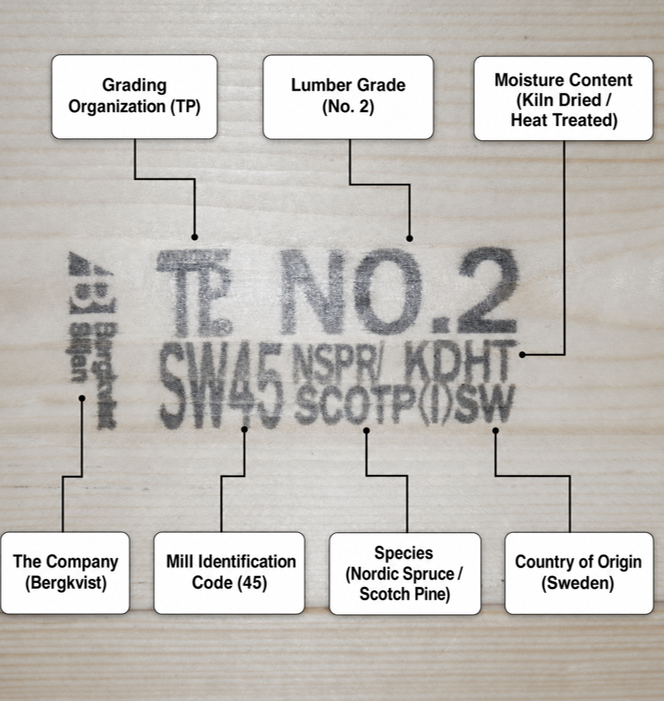
Grading Agency
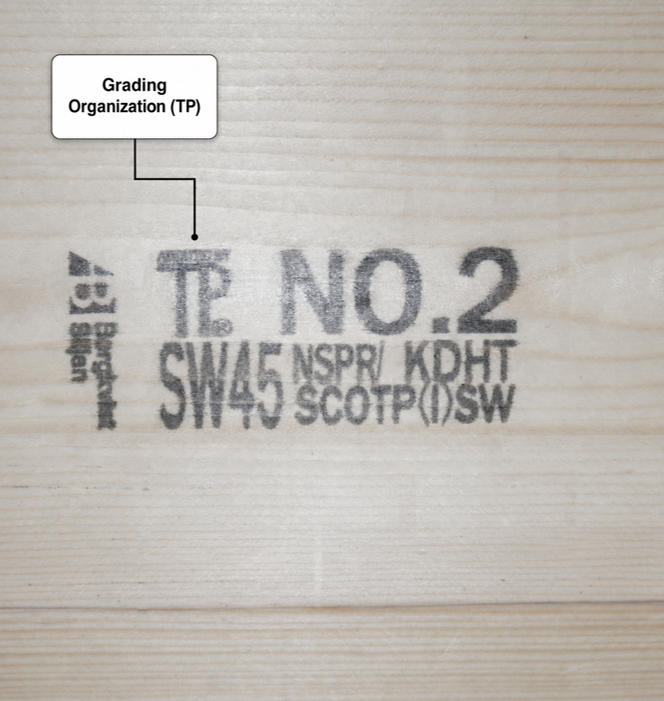
The grading agency’s name or logo identifies the organization responsible for quality supervision. In this example, TP stands for Timber Products Inspection.
Other agency marks you may see include:
| Marking | Grading agency |
|---|---|
| TP | Timber Products Inspection |
| SPIB | Southern Pine Inspection Bureau |
| WWPA | Western Wood Products Association |
| PLIB | Pacific Lumber Inspection Bureau |
| NeLMA | Northeastern Lumber Manufacturers Association |
These are examples of accredited grading agencies. The mark on a particular board depends on the mill’s grading program.
Lumber Grade
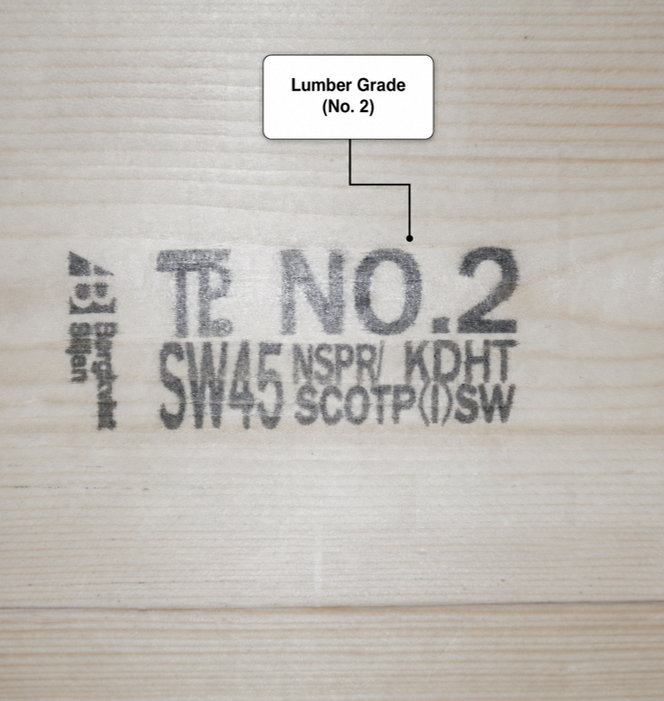
The lumber grade identifies the grading requirements the board meets. For visually graded structural lumber, graders evaluate characteristics such as knot size and slope of grain.
The example shows No. 2. Other grade designations include:
- Select Structural
- No. 1
- No. 2
- No. 3
- Stud
A board can contain knots and still meet its assigned grade. The required grade depends on the product and its intended application.
Moisture Content and Heat Treatment
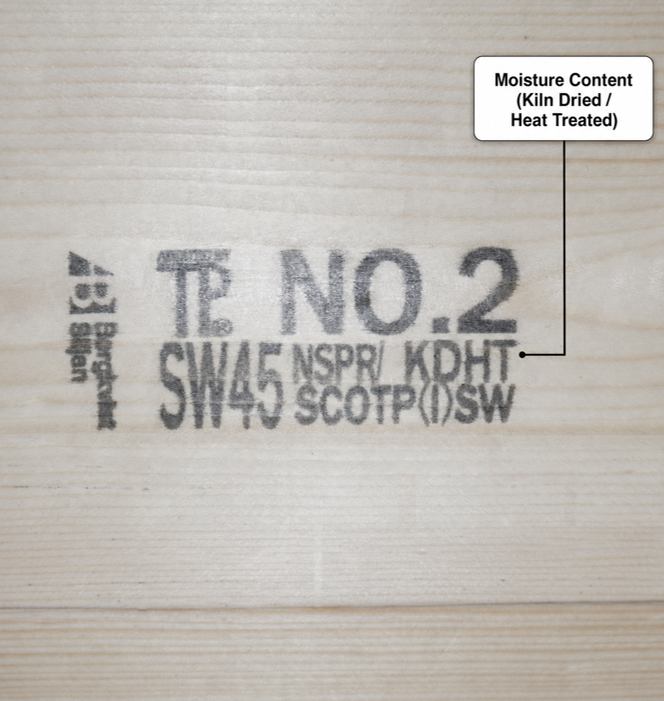
The seasoning designation describes the lumber’s moisture classification when processed. Additional markings may identify heat treatment.
The example shows KDHT, meaning kiln dried and heat treated.
| Marking | Meaning |
|---|---|
| KD / KD19 | Kiln dried; KD19 specifies a maximum moisture content of 19%, while KD follows the applicable grading rules |
| KD15 | Kiln dried to a maximum moisture content of 15% |
| S-DRY | Surfaced at a maximum moisture content of 19%; may be air dried or kiln dried |
| S-GRN | Surfaced green, with moisture content above 19% |
| HT | Heat treated; may appear alongside a drying designation |
Heat treatment addresses phytosanitary requirements. HT alone does not establish a moisture classification, and the seasoning mark does not provide a current moisture reading after shipping or storage.
Mill Identification
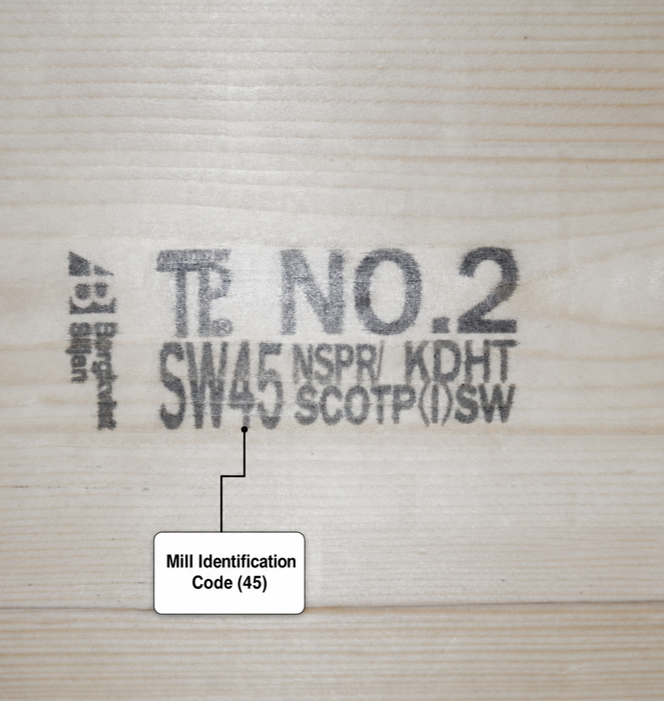
Mill identification provides traceability to the producing facility. The pictured example labels 45 as the mill identification code.
Other mills use different assigned identifiers. A larger mill number does not indicate a higher lumber grade.
Read this identification together with the grading agency’s mark. If you need to confirm the facility’s name or location, the agency can help identify it.
Species
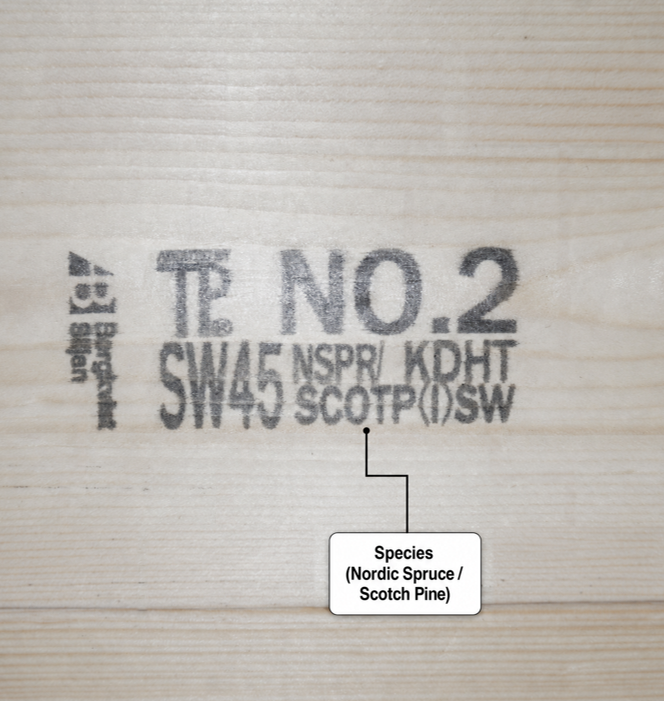
The species designation identifies an individual species or a recognized species combination. This example shows NSPR/SCOTP, identifying Norway spruce or Scots pine.
| Marking | Species or species combination |
|---|---|
| S-P-F | Spruce-pine-fir |
| SYP | Southern yellow pine |
| D Fir-L | Douglas fir-larch |
| NSPR | Norway spruce |
| SCOTP | Scots pine |
A combined designation identifies the species covered by the stamp. It does not mean an individual board contains multiple species.
Manufacturer
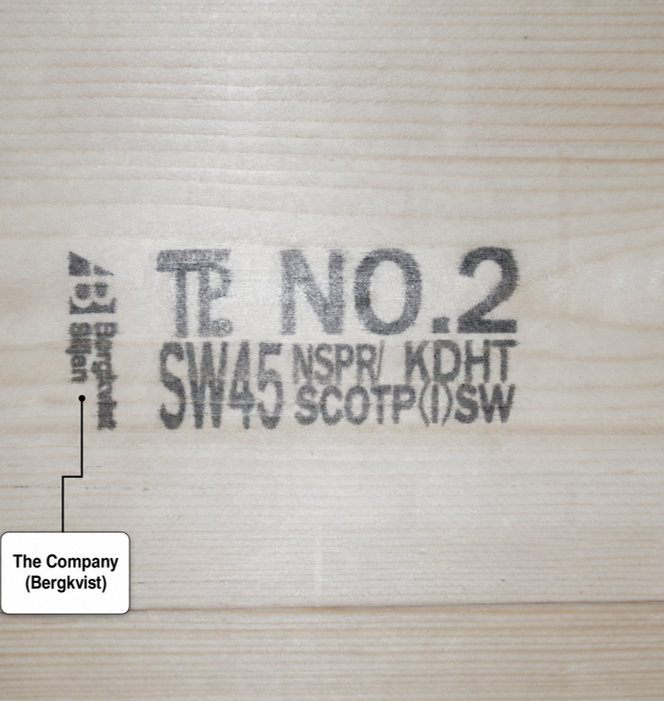
The manufacturer’s marking identifies the company that produced the lumber. This example includes the Bergkvist name.
Depending on the stamp, manufacturer identification may appear as a company name, abbreviation, brand, or assigned number. Some stamps identify the producer through a mill number rather than a separate company name.
Country of Origin
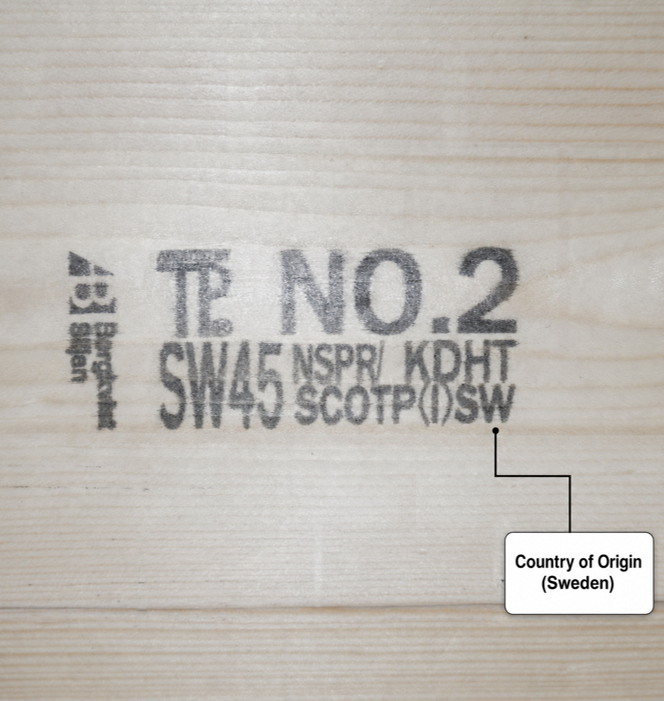
Country markings identify the origin associated with the species designation. In this European example, SW means Sweden.
Examples of European country markings include:
| Marking | Country |
|---|---|
| SW | Sweden |
| FIN | Finland |
| GER | Germany |
| AUS | Austria |
| EST | Estonia |
These lumber-stamp abbreviations may differ from country codes used elsewhere. Not every grade stamp includes a separate country abbreviation, so read the full species and origin designation together.
Check the Complete Stamp
Before ordering lumber, confirm the required species, grade, dimensions, lengths, and moisture designation with your supplier. When material arrives, compare its markings with the order specifications.
Capital Forest Products supplies wholesale lumber for lumberyards and manufacturers. Contact our lumber department to discuss your specifications, truckload requirements, and available supply options.